

The Holy Spirit's guiding presence.
or, God's polyamorous instincts and how the Holy Spirit makes you a third.

Thanks for taking the time to open this email! If you somehow were sent it and you haven’t subscribed, I’d love to have you on the email list—I try to not be annoying and then of course you can always tell me I’m annoying and unsubscribe any time you want. In any case, if you enjoy this post, giving it a ♡ and/or commenting is helpful. It tells Substack I’m worth reading and it tells me what you think about my writing (especially if you comment and tell me what you think about my writing).

Real quick thought about the Holy Spirit.
I’m in Colorado Springs at the moment for a trip that, seemingly, will either be three days or three weeks depending on snow.
I wouldn’t be surprised if we never saw Fred Tally-Foos again.

The bartender at the PHL Chase Lounge (brag) told me I looked like Luigi (brag) and no she did not mean the hot, alleged hero of the people, she meant the hotter of the two famous plumbers (brag) and she’s not wrong I guess? I wasn’t wearing my glasses when she said it, if that matters. You decide.
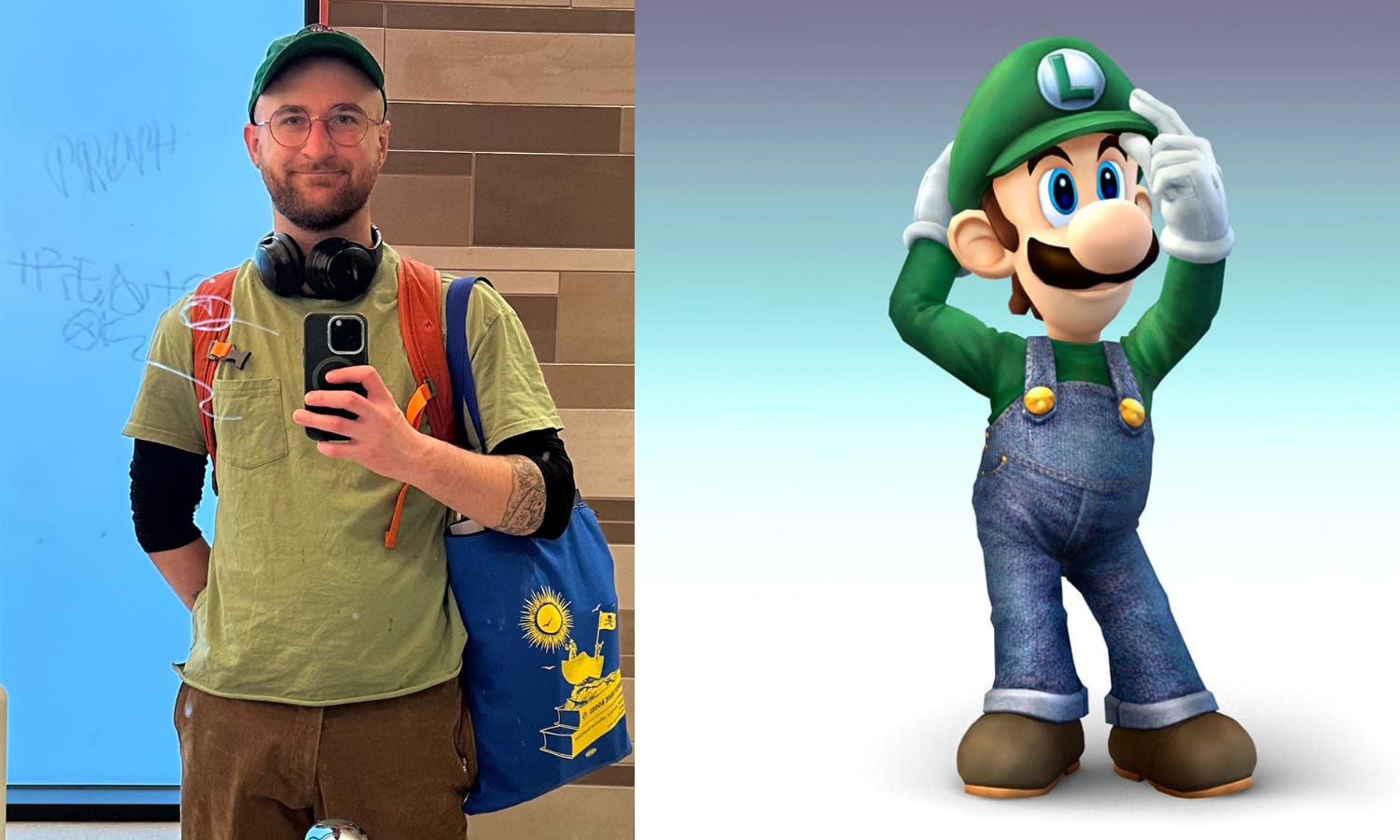
Because of this travel and because I am still getting back into the swing of things, this is a quick little blog I’m shooting off, riffing on some of what I talked about last week.
First, to clarify, I took Sarah Coakley’s commitment to “desire as an experience of divinity” farther and more to a more expansive place than I now think she does. Not that she doesn’t go to interesting places with the concept, but I think she’d be a little more traditional in her differentiating of “graceful” or “fallen” experiences of desire. My suggestion that all experiences of desire are inherently divine-inspired is built on her ideas, but not replicating them. Much more to work on understanding here I guess.
Second, one of the other really interesting ideas she works out is an argument for the Trinity specifically, a purpose for divinity that is seen as “one in three, three in one.” Basically, without the Holy Spirit, there might be a privileged dyad between the Father and the Son, and the Holy Spirit is the means of incorporating us into that exchange. The Spirit does this, Coakley suggests, by joining us into relationship with the Father and Son when we engage in contemplative prayer or some other method of transcendence. She suggests that we are in fact ceding the moment to the Holy Spirit, that the Holy Spirit connects to God through us. I see this connecting with similar ideas from queer theology, specifically those by Marcella Althaus-Reid and her suggestion that certain trinitarian approaches offer “a Queer way to re-discover God, by active observation of God’s polyamorous relationships as in the figure of the Trinity.”
In either reading, that of Coakley’s transcendent contemplation or Althaus-Reid’s suggestion that the Trinity is a model of queer, boundary-breaking love, the Holy Spirit can be seen as that which invites (guides) the pray-er into the fold.
Experientially, this rings true to me. If you’re going to entertain a trinitarian model of the divine, the expansive, always-there quality of the Spirit has long been associated with a grassroots kind of worship for a reason. I’ll have to hold on getting into this more deeply until next week, but for now just consider how people who are “taken by the Spirit” might come from all walks and all classes of life. It’s an entry point that, more than the Father or the Son, tends to feel accessible, reachable, to even the least “trained” or “elite” worshippers.
Have you ever felt the Spirit? What about the Father or the Son? I feel obligated to note that, according to Christian orthodoxy, if you’ve met one, you’ve met them all. All in one, one in all, etc. Still, I’m curious, what face, what voice have you known in the divine? Who feels out of reach and who do you feel is most near?

Thanks again for reading! I’ll be back with a lengthier, more researched letter next week, but for now I’m stuck in Colorado and making cow sounds with my niece. Duty calls.
Always a lot of credit goes to the people who have been my teachers, both directly and through their freely shared knowledge, and so many books.