

Desire, i want to turn into you: theological edition
or, wow, somehow we got to 100...

Thanks for taking the time to open this email! If you somehow were sent it and you haven’t subscribed, I’d love to have you on the email list—I try to not be annoying and then of course you can always tell me I’m annoying and unsubscribe any time you want.
In any case, if you enjoy this post, giving it a ♡ and/or commenting is helpful. It tells Substack I’m worth reading and it tells me what you think about my writing (especially if you comment and tell me what you think about my writing).

It’s probably meaningful in some way that the newsletter I broke off on last year, the one that I didn’t send, that almost died a death of inertia, is my 100th newsletter. But, here we are, resisting the inertia.
Happy 2026 and happy 100th Ask Good Questions! I don’t know exactly what’s going to happen here this year, but I am working on consistency again. I’m prioritizing my priorities. Of course, perfection is the enemy of doing anything at all, so I’ve let myself get a few weeks into the year without sending this first newsletter. Still, however bumpy the process is, I’m getting back to that weekly frequency I held for a while. I was proud of that and I made some meaningful connections, with new and old friends. Thanks for sticking around.
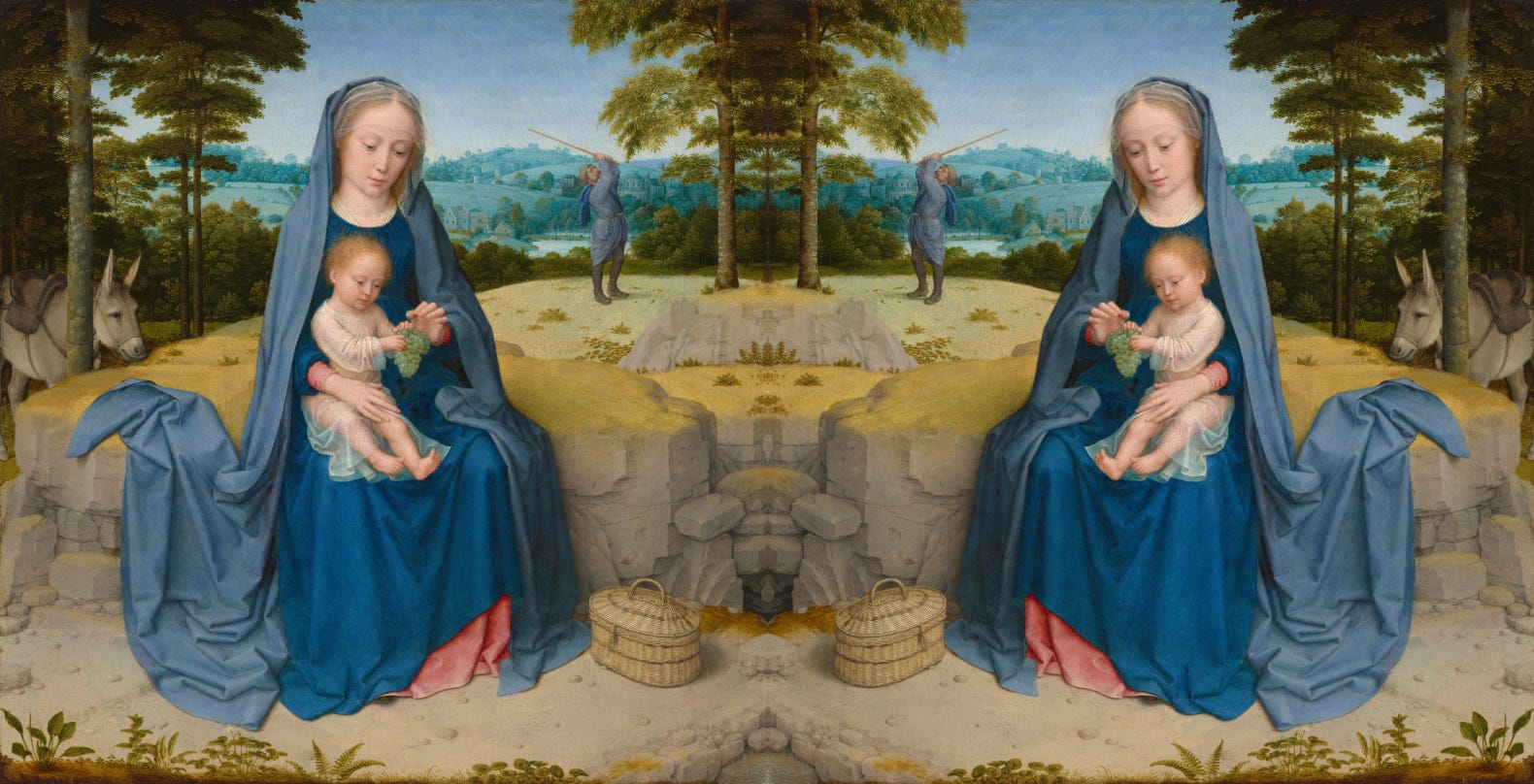
Desire, I want to turn into you: theological edition.
I’ve started my second semester of school this week. I’ve got two courses this spring: (1) God, Christ, Holy Spirit and (2) Mary, 1500 - Present, each taking up three hours one evening every week. I was talking with a friend about how nice it has been to develop some depth in a single subject, to allow myself to specialize. This isn’t how I’d ever felt about learning when I was 18-22 years old, allergic to structured majors and required courses. I still have that allergy, but it’s not as life threatening as it once was. I do understand now the appeal of building a bench of writers and topics that you can trace throughout a concentrated subject.
I’ve also begun to realize that I really can’t do all the things I want to do. Duh, of course. Still, as obvious as this is, I spread myself too thin last semester, even though I spent most of my time in my apartment. Somehow, even though I was physically locked in, I was losing attention for a long list of reasons that were all legitimate, but that overall did not need my attention specifically. So, I am making a meta goal this year to be more disappointing to people. Not exactly “be more selfish,” though this impulse does have a certain spiritual connection to the late-Millennial/early-Gen Z attitude of “you don’t owe anyone anything.” I do owe many people many things, but I see this year as as good a time as any to test whether or not putting the vast majority of my resources toward my own interests and wants will lead to any kind of change (positive or negative) in my life.
I hosted my friends Kinsey and Max in Philly before and after New Year’s, and, unsurprisingly, once Max got here we gave each other hand poke tattoos. I started doing this to myself (badly) back in 2019, though my interest has waned and waxed through the years. In that time Max has been my most consistent tattoo recipient, getting at least as many as I’ve done to myself and maybe more. Since Max was here and since Kinsey was going to have fomo if she left right before we did tattoos, she pushed her scheduled departure back. Max and Kinsey exchanged little squiggles (they drew them, I tattooed) and I gave myself a take on the Amazing Bone from the William Steig book of the same name. Then, before Max left the next day, he and I gave each other spiral tattoos. This was the first hand poke that I’d gotten in return from Max and I think he did a great job—jury is out if the less aggressive (less painful) method that we landed on this round will have staying power, but I am optimistic. Ultimately these tattoos are less about the art and more about some kind of connection. Blood brothers vibes I guess?1 Yikes.
One of the ridiculous goals I set for myself after that flurry of tattooing was to give myself a tattoo every week of 2026. In my defense, the Amazing Bone tattoo that I did was very small and warped my sense of what that would really mean. So, after completing my second tattoo (big ol’ circle), I’m deciding that instead I’ll do at least one tattoo per month and each tattoo will push my skills a little farther. Worst case scenario, I’ll have some sketchy little illustrations on me that will cover up very easily. Best case, I begin my tattoo bartering career. Win-win, or at least a “not lose-win.”


A non sequitur: I’ve been assigned a book for class that I started reading last year: God, Sexuality, and the Self: An essay ‘on the trinity’ by Sarah Coakley. Sarah Coakley is an Anglican priest and academic, one of the more creative and significant theologians working today. She does a lot of work on the history and value of Christian contemplative practice which is much less derivative of non-Christian religious practices than you might think if you only experience them via Instagram. Unsurprisingly, the concept of meditation and inner stillness is one that seems to have roots in the foundations of most cultures globally. In this book, she’s arguing (among other things) that contemplative and ascetic modes of prayer are theologically rich ways of “doing” systematic theology. Basically, she argues that developing these kinds of wordless, self-emptying, deepening practices are effective, necessary ways to approach and “redeem” a long list of otherwise harmful or sinful impulses.2
All of this more practical theorizing is built on top of the less actionable, but maybe more important, assertion she makes that Desire is an ontologically central principle of the Trinity, that is, of God.3 By this logic, Desire is knotted up deeply inside God. By this logic, Desire is part of what God is.
She goes on to build out “a vision of God’s trinitarian nature as both the source and goal of human desires,” suggesting that, when engaged with contemplatively and ascetically, our experience of Desire (which is often torturous, ask any Buddhist) can grant us a line of connection to the divine. This is possible because the divine’s manifestation of Desire can be felt in a slantwise way through our own experience of Desire. This is an apophatic connection, a connection that can’t be put into words and doesn’t necessarily benefit from the attempt. Coakley goes on to say, “Desire, on this view, is the constellating category of selfhood, the ineradicable root of the human longing for God.”
If this sounds like annoying religious waffling, that’s fair, it kind of is. Sarah Coakley is not the most approachable writer, though I think there’s a lot in her work for anyone interested in spirituality. What I take her to mean here is that Desire, even sexual Desire, even Desire that you might feel is “pointed” at the wrong things, the wrong people, the wrong experiences, is a way of connecting with and understanding God. Now, I think I imagine a different God than Coakley does, one that is probably not exactly Trinitarian, one that is not strictly Christian, but that is still animating and universal. But whether you like to think of Coakley’s God or my God or any other God, the idea that the uncomfortable longing, desiring, hungry, barren wanting that we all know better than we wish might be turned on its head and understood as the divine is significant. In Coakley’s Trinitarian language (remember, God and Spirit are the same and distinct), “the Spirit is that which propels the one who prays towards union with the Divine, but whose tug is felt analogously also in every erotic propulsion towards union, even at the human level.”
Coakley goes on to make an interesting point about how countercultural it has become to “sublimate” desire, specifically in the context of sex. She doesn’t make this point in a finger wagging, “why is everyone f*cking so much??” way, rather, she implies that we don’t have many good models for reasonable abstention any more. She points specifically to the ways that repressed sexuality of the clergy (Catholic or otherwise) has often been diagnosed as the cause of Church sexual abuse. While I don’t know a lot about this, it feels like a good read on the situation. Coakley, though, argues that we shouldn’t then conclude that all denial of desire is “monstrous.” It’s central to her theology that there is value in the ascetic—not in all ways and at all times, but in significant ways and at key times. Some kind of beauty in the struggle.
This part of her theology makes me think of other countercultural modes of being and how we can resist another often insidious expression of desire: overconsumption. The hunger for more, more, and more.
This ascetic train of thought brings up straight-edge punks and their resistance to alcohol or drugs, brings me really to any form of sobriety in an inebriated world. I think about BDSM and the ways people experiment with negation and denial, with anything from edging to chastity hardware. I think about nonviolence and the beliefs and practices that enable people to refuse to take the bait of murderous systems, even when it would be expedient to simply fight fire with fire. And all of this makes me think of the pause between stimulus and reaction, the pause that practitioners of all kinds of mindfulness (secular and otherwise) seek. Coakley’s arguments seem to have connective tissue to these forms of attraction and abstention, though I don’t believe she references any of them directly. I haven’t read the entire book yet, so I’ll find out and share as I learn more.

Thanks again for reading, I’m excited to be back! If you have any questions about God/Christianity/theology/anything, please let me know! I probably don’t know the answer, but I enjoy pondering the questions.
Some things to read:
Sarah Coakley’s book is available here, but you can also read a good piece of hers about prayer and contemplation here for free.
If you’ve never read official Catholic publications from the Vatican, they are a trip. Here’s a recent one I read for class about how people “should” talk about Mary and how they “should not.” Humans are incredibly odd animals.
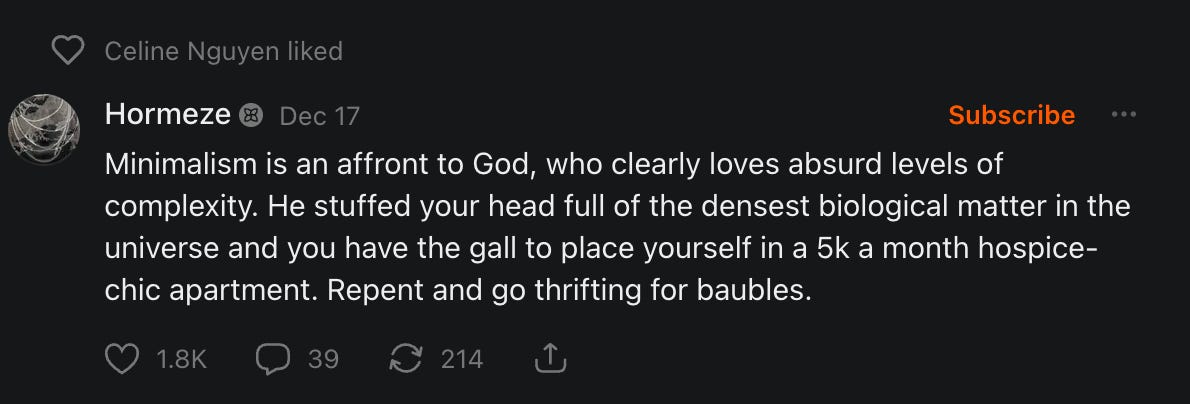
This Note right here:
Do you work for an evil company? Are you actually so good though, despite that?
Always a lot of credit goes to the people who have been my teachers, both directly and through their freely shared knowledge, and so many books.
We are completely sanitary and no blood is exchanged I promise 👨🏻⚕️
“Sinful” is not useful to me, but it’s the terminology she uses so I don’t want to misrepresent. I did a little writing on “sin” last year, but I’m due for a “come to Jesus” (lol) confrontation with sin soon.
And the Son and the Holy Spirit — Coakley’s theology really only works with a strong trinitarian bent which is obviously not to everyone’s liking, though it is to Christians.