

Writing poetry with ghosts
A Jupiter in Leo story.

Thanks for taking the time to open this email! If you somehow were sent it and you haven’t subscribed, I’d love to have you on the email list—I try to not be annoying and then of course you can always tell me I’m annoying and unsubscribe any time you want. In any case, if you enjoy this post, giving it a ♡ and/or commenting is helpful. It tells Substack I’m worth reading and it tells me what you think about my writing (especially if you comment and tell me what you think about my writing).

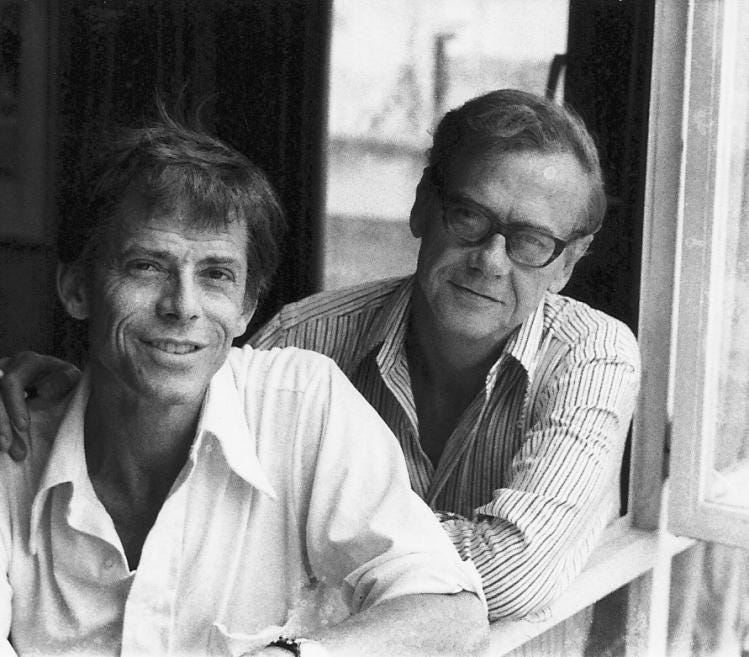
Notes on James Merrill and Jupiter in Leo.
I am being vintage this week, in the sense that I’m writing a blog about astrology. It’s been almost a year since I’ve written anything specifically about astrology and at least six months longer since I was writing almost exclusively about astrology. Some of y’all might have come here expecting more about the stars and some of y’all might even be surprised to learn that I am an erstwhile astrologer.
I say erstwhile because school has kept me from much active astrology-ing or taking part in Larry Arrington’s amazing Friends of Dorotheus astrology workshops/meetups. Still, I’ve never stopped looking to the sky and taking note of which bright planets are most dramatically making their presence known on any given night. If nothing else, it’s a good way to remember that there are big things happening right in our line of sight that we don’t have even the illusion of control over. Those planets and stars just keep wandering the sky whether we say or do anything about it.
The big news recently has been Jupiter’s move from Cancer into Leo. This is technically a downgrade for Jupiter, though that’s an oversimplification. While Cancer is the sign in which Jupiter is exalted, he’s got some dignity in Leo due to his affinity for the fire signs. Also, speaking from outside any real astrological tradition, there’s just a sympathetic energy between Jupiter and Leo. Sure, the Sun is technically king in Leo, but we might think of Jupiter as the Sun’s chiller little brother, the people’s prince, happy to vibe by the pool.
A word I used to beat to death in my poetry was “laughingly.” I like to think that Jupiter, especially in Leo, works laughingly. A little bit of absurdity, a little bit of excess, a little bit of luck. Laughing laughing laughing.

In1955, James Merrill and David Jackson began writing The Changing Light At Sandover. More accurately, in 1955, they began working with the spirit Ephraim via a ouija board and open notebooks on the text that became The Changing Light At Sandover. It’s one of the great epic poems of 20th Century America, I think. As they asked questions, Ephraim gave them answers, sometimes with a tongue in cheek tone and sometimes with utter seriousness. Whatever he brought them, they wrote it down, doing their best not to edit, but to channel.
As Merrill says, first he tried to rearrange what they learned into prose, unsuccessfully. He says: “That such a project was beyond me merely / Incited further futile stabs at it.” It wasn’t until he really let go of his personal expectations and tried to stop trying that things got clear.
The more I struggled to be plain, the more
Mannerism hobbled me. What for?
Since it had never truly fit, why wear
The shoe of prose. In verse the feet went bare.
Through this barefoot verse, Merrill and Jackson learned and shared how things worked on “the other side.”
They met their guardians, were briefed on the lifecycle of a soul, and reconnected with lost loves and lost potential. They kept up the ritual through the seasons, cranking up a space heater and wrapping themselves in wool blankets when the cold Connecticut winter set in. Over the years, they began to understand their conversations in new ways and introduced their living friends to their secret world, chasing every tangent to and past its logical conclusion. It’s crazy, frankly, and it’s a lot of fun to read.
I’ve talked before about Robert Bly and his concept of “leaping poetry,” his belief that only in poetry can one release the ballast and float away from the literal to the impossible-but-true. This world, the impossible-but-true, is basically my focus–religion, poetry, astrology, philosophy, etc. That’s not to say it’s better or more useful than the literal and the concrete and the measurable; as they say, “in this house, we believe in science,” but no one gets to pick where their own compass points, not really. So, do you fight it? Or do you start walking?
By the time Merrill and Jackson collected the works they’d created with Ephraim’s help, it was 1982, and they’d surely begun to lose friends to the AIDS virus. I have to assume their rituals of communing with the dead were simultaneously feeling more important than ever as well as painfully thin at times. At the same time, I don’t want to assume how they felt, because everyone I’ve ever spoken to who lived through it and was paying attention surprises me. Some things are too complex to describe directly.
It wasn’t until I’d begun doing some outside reading about the poem and about Merrill to write this blog that I realized he had also died of AIDS-related complications. Not surprising, to be fair, but something doesn’t have to be surprising to be tragic. What was more surprising was to learn that he died on February 6, 1995, two days before I was born. These things happen and we only notice them because we’re primed to notice things that feel relevant to us. These are the coincidences that, when described to a neutral third party elicit, at best, a raised eyebrow. From within the world of The Changing Light At Sandover, though, coincidences are more slippery things. Coincidence is how a spirit communicates. Coincidence can be what you want it to be.
For what it’s worth, when those two gay men and the spirit they befriended began writing that long poem in 1955, Jupiter had just moved into Leo, just as Jupiter has moved into Leo this week. I like to think there’s something about that kind of automatic writing, that kind of writing that is inherently spiritual in one sense and that is overflowing with gall in another, that suits Jupiter in Leo. It’s the heat of delusion, the flush of laughing too long, and the risk of playing along.
I mean really, you’re telling me a ghost wrote this poem?
Sure, why not?
Always a lot of credit goes to the people who have been my teachers, both directly and through their freely shared knowledge, and so many books.