

The power to save the world is... yours?
and other half-truths I learned from Captain Planet.


Hello friends, from a heat dome afflicted, smoggy Philadelphia.
I won’t complain too much, because this week has brought much more discomfort and disaster to many people than what I’m experiencing. The Texas Hill Country has once again flooded in ways that should occur only every 50-100 years, just one year after flooding in the same river snuffed out over one hundred lives. Even in Philly, it gets a lot worse than my slightly overheated apartment.
Still, there is a specifically bad kind of feeling where it’s unseasonably hot, so you need to use your air conditioning all day, but inconceivably large forest fires are sending smoke and who knows what particles into the air that gets pumped inside by those air conditioners. Also, using the air conditioners contributes to future climate disasters.
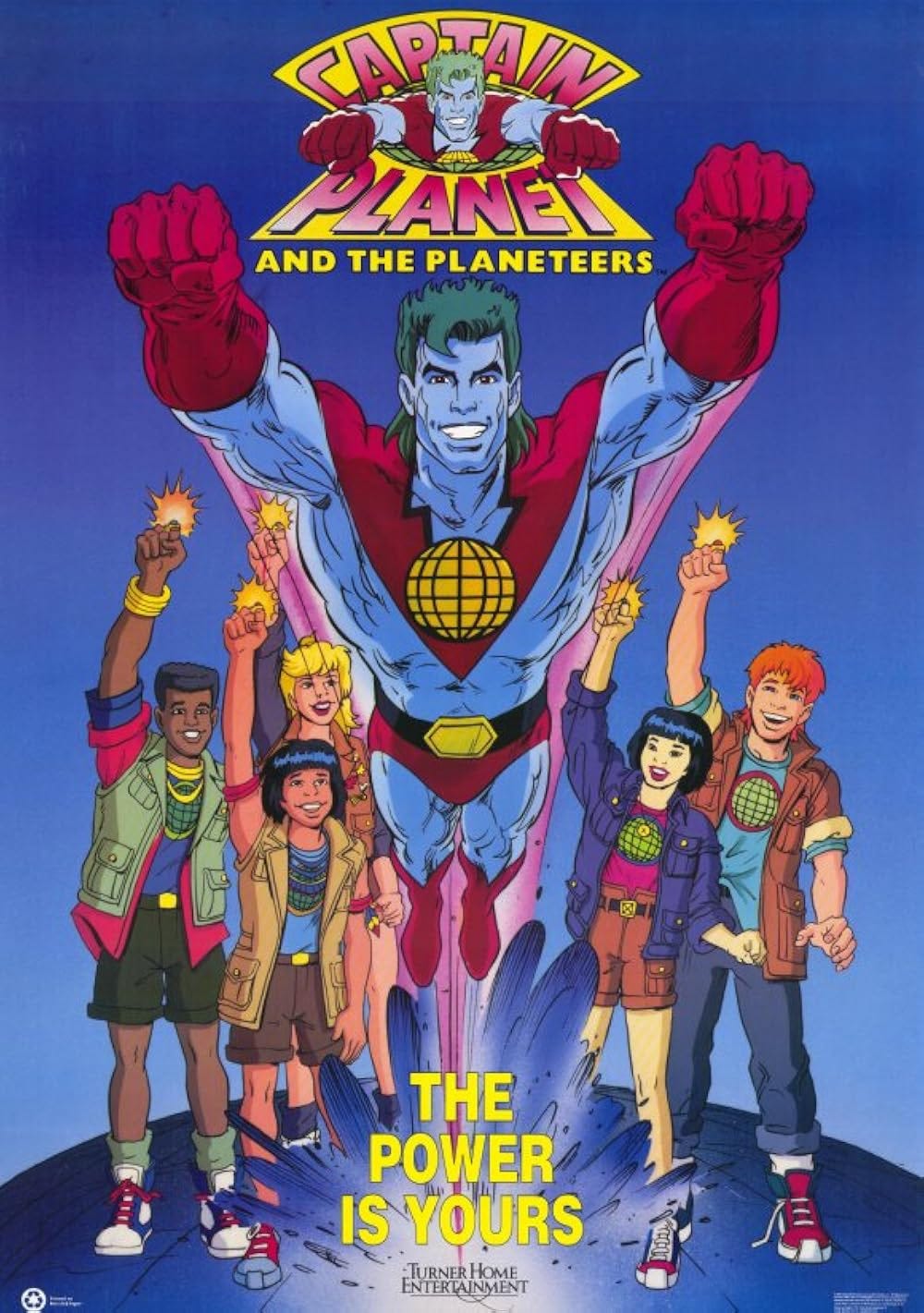
Inevitably, when I’m in the middle of a climate collapse-based situation, I think about Captain Planet. I watched the show a lot as a kid. I recently re-watched some of it and it’s pretty spectacular how different it is from what I understand to be on TV for kids these days. There’s that joke about how playing Charli XCX for a pilgrim would cause them to explode, but I almost think taking a kid from today and putting them in front of a TV (that is deeper than it is wide, of course) and hitting play on a couple episodes of Captain Planet might also cause them to explode.
Based on plot lines from Captain Planet, one would really think we’d have figured out “the environment” by now. Really, how hard can it be? All we have to do is stop poaching endangered animals, recycle our plastic bottles, and turn off the light when we leave the room, right? The power is ours, right?

There’s a section early on in Laudato sí, Pope Francis’s encyclical on the environment and climate change, that I think is worth quoting at length. Despite it being a decade old, it’s resonant. The section comes after Pope Francis first invokes his namesake, St. Francis of Assisi, and is a reflection of what Pope Francis thinks we can learn from the saint:
If we approach nature and the environment without this openness to awe and wonder, if we no longer speak the language of fraternity and beauty in our relationship with the world, our attitude will be that of masters, consumers, ruthless exploiters, unable to set limits on their immediate needs. By contrast, if we feel intimately united with all that exists, then sobriety and care will well up spontaneously. The poverty and austerity of Saint Francis were no mere veneer of asceticism, but something much more radical: a refusal to turn reality into an object simply to be used and controlled. - from Paragraph 11, Laudato sí, emphasis my own.
I like this way of thinking about asceticism which can so often feel like a turning away from the world. Instead, Pope Francis suggests here that it’s actually a means (an extreme means, perhaps) of deciding the terms by which you’ll know the world. The idea that denial of our impulses, specifically the impulse to consume, is a way of de-objectifying the world sits better in me than the idea that such restraint is in some ways a means of “fixing climate change.”
It’s unlikely that my turning off my air conditioner once it gets below 90 degrees will mean much for the environment. Like the question of recycling when most of what we recycle either goes to the landfill or is shipped to other countries, individual climate action can feel like playing a rigged game that everyone knows is rigged. At times, it really doesn’t feel worth it. What these things can do, though, is help me remember to not objectify the world around me which is worth it in a different way, one that is counterintuitively internal.
While that internal value isn’t going to be enough to get private jets out of the sky or to entice our government to tax the wealthy and invest in a Green New Deal, it’s still important. It’s important to resist the pessimism and depression that comes with steeping in our consumer culture, to stand in contrast to those who profit (in the short term) from the destruction of the planet.
When we stop objectifying the world, we get better at not objectifying other people and at not objectifying ourselves which overall supports the movement against capital. Resisting objectification makes it harder to be “used” as a buyer, as a consumer, as just a thing to be moved around by the mysterious forces of the market. Then, hopefully, we can understand each other, understand the plants and animals and inorganic stuff of the world, as interdependent subjects that are capable of standing up for ourselves and for each other. We’ll have to.
I hope you’re staying safe out there, as always, thanks for reading!

Always a lot of credit goes to the people who have been my teachers, both directly and through their freely shared knowledge, and so many books.