


Thanks for taking the time to open this email! If you somehow were sent it and you haven’t subscribed, I’d love to have you on the email list—I try to not be annoying and then of course you can always tell me I’m annoying and unsubscribe any time you want.
In any case, if you enjoy this post, giving it a ♡ and/or commenting is helpful. It tells Substack I’m worth reading and it tells me what you think about my writing (especially if you comment and tell me what you think about my writing).

Some notes from my academic personal statement.
The best way I’ve found lately to kill time and avoid writing my final papers for school is to type away at a document called “Academic Personal Statement In Process.” If I want to know what I think about something, I’ve found it’s much easier to make something that I can react to, an opinion that could be mine, and then to see how it feels once I try it on. Is this how you think through things too?
It’s been a challenging puzzle to articulate an Academic Personal Statement, even “In Process.” When you study theology, when you study religion from the inside of itself, there are some natural obstacles. It’s like studying the whale from inside the whale’s stomach, but someone might look at you there and say, “hey, the whale isn’t real.” and you have to say, “no, I know, or, like, what do you mean by real though? it’s real, in a sense, in some meaningful sense, right?” And then the person shakes their head and continues on, and you’re back to wondering: “putting aside the whale, am I even real? and why?”
Because theological questions, in my experience usually do boil down to “what’s the point of life” or “what is there to do with life” or “how should a person be” or a similarly broad and naive concern.
Not naive because it’s not important, that’s not what the word means, of course. Naivete is a way of being that usually applies to me when I’m dealing with something actually pretty important; money, love, and politics, for example, three areas of life I consistently reveal myself to be naive. So, “naive” not as simple, but as a less self-conscious version of precocious. Naive in that it shows how little you understand your own limitations. Theology as the study of religion from the inside is very much about not understanding your limitations, putting your limitations down, and wondering what it would be like if those limitations were picked up by something else and carried to a place you would not otherwise have found.
So far, what I’ve learned about myself writing this personal statement, is that I don’t feel like I am studying religion so much as I’m using religion to study life. I’m beginning to see “faith and practice” as a kind of methodology for inquiring into those big, broad, naive concerns rather than as being the content of inquiry itself. This has at least a handful of interesting consequences.
First: when I understand religion and faith as a methodology, it helps me understand what to do with it even if I cannot say the Apostle’s Creed without simply lying. That has been a tension I didn’t have a fix for for a very long time. How firm does a belief have to be for it to be fruitful? Is there value in doing the practice of the worship anyway?
This idea isn’t so far off from what Catherine Mowry LaCugna suggests when she says that true theological work must be doxological, must be done through prayer and in worship. It’s only a difference of stance, a difference of whether or not you think this move is accessible to the non-believer. I guess it also asks whether or not you think the believer and the non-believer are all that different to begin with.
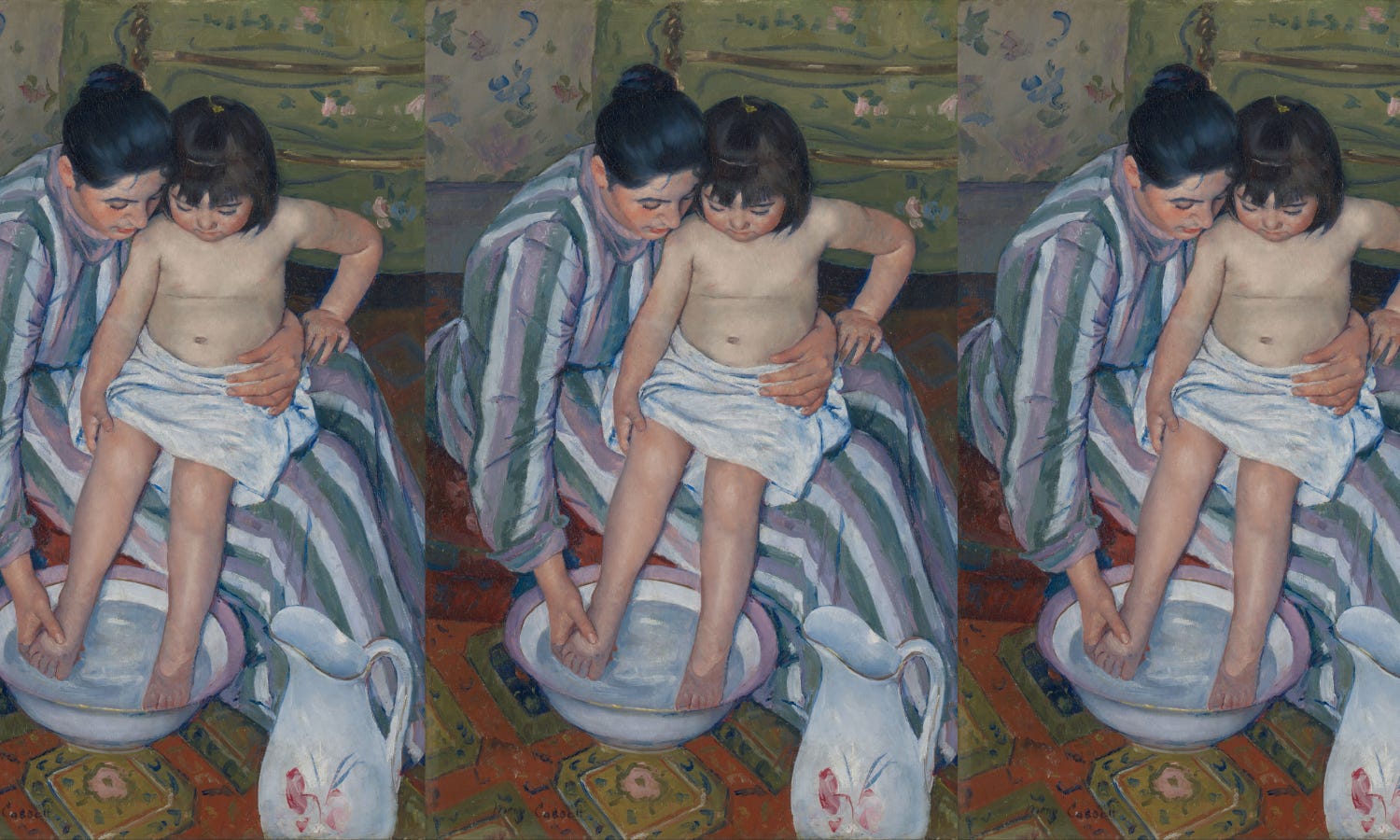
When you’re a painter, I assume, you learn to paint from the masters, from studying the masters, even if you never intend to paint in a strictly classical style. I assume one must look at a painter like Renoir or Cassatt and think, “How’d they do that? What steps got them there?” and then, through re-creation, try to learn something about the heart of painting, about the heart of seeing. The artist should create something new, something Cassatt wouldn’t ever have thought of, but that is only possible to create having studied Cassatt. This is how I feel about studying Catholicism from the inside. There’s impressive work that has been done here using delicate, finely tuned tools; if I learn how “the masters” used these tools for their own ends, what might I do with them?
Second: I can begin to disambiguate the ways that I feel like a Catholic, a Quaker, a Universalist, an anti-theist, a Humanist, and like someone deeply invested in catholicity, and that disambiguation is meaningful. I have interest in and appreciation for a wide variety of faiths, not all Christian, but I have history and experience with only one, really, two if you count Humanism, three if you count astrology which is a cosmology more than a religion. That these means of being religious, these varieties of religious orientation, might be considered methodological choices makes it easier for me to see them as different ways to engage with the same core questions, different ways that most likely have very different advantages for working with those questions.
Paul Tillich says in The Theology of Culture, “You cannot reject religion with ultimate seriousness, because ultimate seriousness, or the state of being ultimately concerned, is itself religion. Religion is the substance, the ground, and the depth of [humanity’s] spiritual life. This is the religious aspect of the human spirit.” The state of being ultimately concerned is one we cannot release ourselves from even if we try, so we ought to be intentional about where and how we direct that concern. These religions, these practices, are ways to direct humanity’s ultimate concern, but so are Consumerism, Domination, Racism, and Classism. Most people don’t choose those religions intentionally, but I have started to wonder if they don’t naturally fill any gaps we leave empty in our hearts and in our days.
Does this imply I think people are intentionally deluding themselves when they call themselves a Christian or a Buddhist or an Atheist? Am I diminishing religious beliefs and schemas to some kind “opt-in/opt-out social club” or to a tool in a toolbox? No, or I don’t mean for to.
Re: LaCugna’s argument that theology and religious studies should be worshipful, I think these methods work best probably when they’re “worked” by people who hold strong belief. When the person doing the scholarship, the doxological work, isn’t faking it to themselves or to anyone else, they can get much closer to those big questions like “what’s the point of life” and “how should a person be”. In that sense, I might be acknowledging significant personal limitations to my work in this field unless I find a way to undergo a spiritual conversion. Alternatively, I might just be naming the same journey that everyone must go on, whether they know they do or not, a journey to the point where you make a choice of some kind. Maybe I’m just acknowledging that religious belief must always involve at least one free choice, one instance of free will: do you choose to see the whale? Do you let the whale swallow you whole?

The reason I wanted to spend some time picking at the ideas that I’m exploring in my academic personal statement, aside from wanting to use you all as a captive audience who can’t help but encourage my improving the statement, is that it underlies more or less all of my writing.
One of the ways I’m going to be able to keep this project going, keep writing for real people (i.e. not academics), is by doing more writing about my studies here. Hopefully that is of interest! It won’t preclude astrology and the Enneagram, because those are two areas of interest that also can’t help but work their ways into my academic work, but I wanted to give fair warning.
Next week we’re back on a more Enneagram-focused blog, that “9 things I’ve learned working with the Enneagram for 9 years” post—assuming as my first true listicle that it will go wildly viral—so watch for that in your inbox / on the Substack app!
Some things to read:
I could’ve saved you some time and instead of reading my blog you could’ve read this by Annie Dillard. Or, you know, you could do both.
This blog by Beatrice Marovich, an interesting non-religious theologian in the field, about how America demands you carry your religious passport with you wherever you go.
I’m going to be referencing a lot of Octavia Butler in the coming months, so if you haven’t read Parable of the Sower and Parable of the Talents or her Lilith’s Brood trilogy, you should visit your local library and get to it!
Always a lot of credit goes to the people who have been my teachers, both directly and through their freely shared knowledge, and so many books.