

How'd I find the Enneagram?
or, how did the Enneagram find me?

Thanks for taking the time to open this email! If you somehow were sent it and you haven’t subscribed, I’d love to have you on the email list—I try to not be annoying and then of course you can always tell me I’m annoying and unsubscribe any time you want.
In any case, if you enjoy this post, giving it a ♡ and/or commenting is helpful. It tells Substack I’m worth reading and it tells me what you think about my writing (especially if you comment and tell me what you think about my writing).

How’d I even start to learn about the Enneagram and why did it stick?
When my friend Kate first told me about the Enneagram, this “personality test” that a guy at her last summer internship made the interns take, I was surprised I hadn’t ever heard of it.
At the time, I was a newly minted “Learning and Development” professional and I’d devoured all the literature I could find on DiSC, MBTI, StrengthsFinder, etc. I was the person at the bar who was going to talk your ear off about the nuances of the MBTI stacked styles of perception and judgement, even though, when pressed, I’d have to admit that my type didn’t really fit me all that well. I was, honestly, annoying.
The Enneagram type that Kate had gotten on the test at her internship didn’t totally resonate with her and the type I got only resonated slightly more, but that didn’t feel unusual. There had always been a bit of stretching required to make the other personality systems make sense, so I figured that was all it was. Since I’d never had a salary before that summer and I was determined to spend as much of that money as I could, I logged onto Jeff Bezos’s bookstore and ordered a stack of books about the Enneagram. One that I came across was The Christian Enneagram by Richard Rohr, which sent a chill of recognition through me.
I knew Rohr as the most palatable Catholic writer out there. Ever since my mom first came across him, I’d been signed up for his newsletter. In college, when I was out late drinking at some gross North Campus house party, getting the Richard Rohr newsletter in my inbox meant that I’d probably pushed it too far and needed to go home. I didn’t read his stuff obsessively, but I liked it and I saw him as a “serious writer” who wrote about “serious things” like religion and sobriety and the contemplative life. I was surprised to see that he’d written a book about what I thought was a silly personality test. I dropped it in my cart.
These days, The Christian Enneagram isn’t the book I’d recommend to any Enneagram beginners. It’s more of a “significant relic” in the history of the Enneagram than it is a meaningful learning resource, veering into some racist profiling and other 90s personality “wellness” writing that smacks of essentialism. Still, looking past those bits, reading through his type descriptions, I began to feel more and more of those thrills of recognition. The test had clearly mistyped Kate and myself, but we were in this book, described in other types. The system could still name us correctly. I began sending pictures of relevant sections to my most active group chat, telling them what I thought their types were with the excitement of any convert.
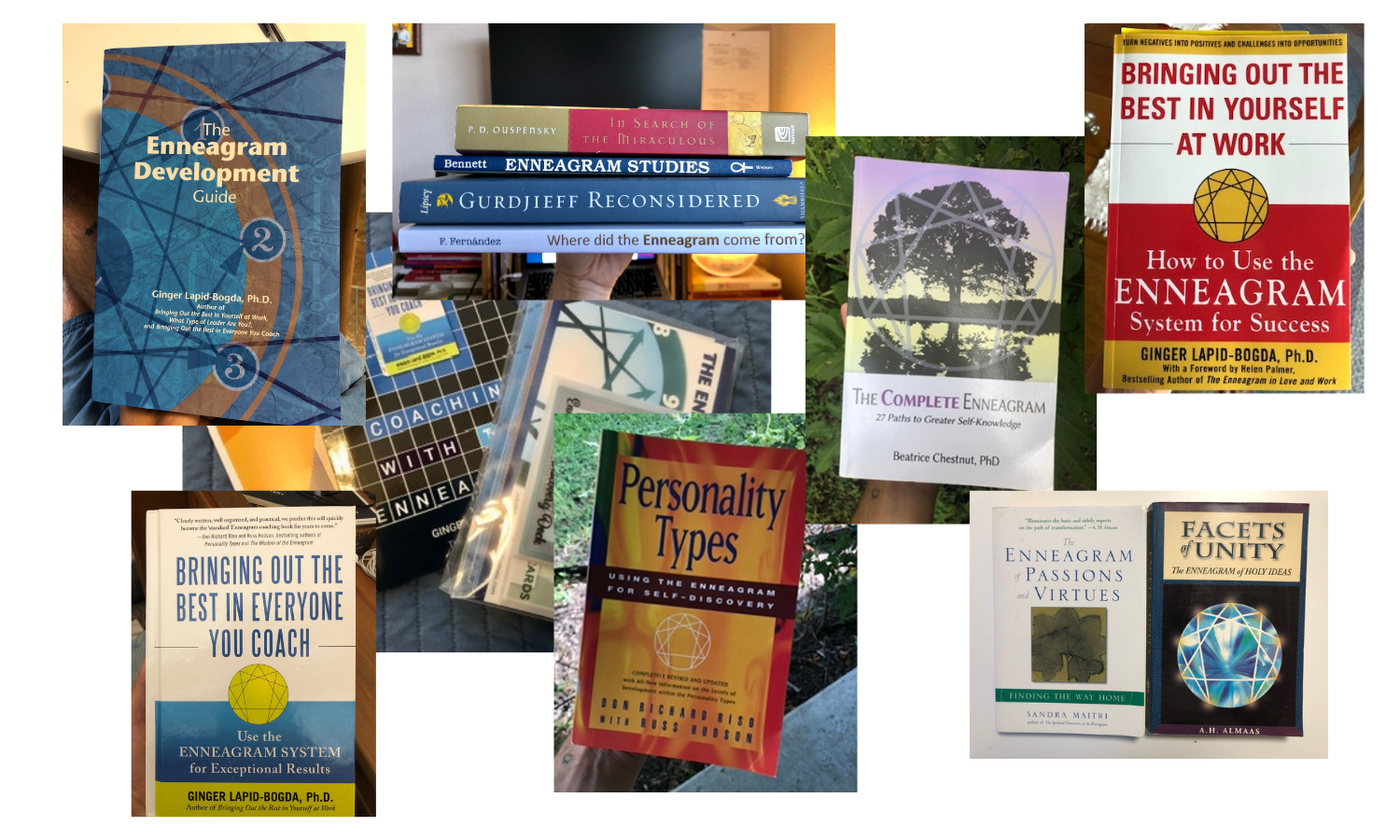
After the first books came the rest, truly any book I could find about the Enneagram. This was in 2017, before the recent rush of Enneagram books put out by mainstream publishers. Many of the books I collected early on were put together by small presses or self-published by the authors. There were a couple podcasts, again primarily directed at Christian audiences, that I listened to on repeat. Interviews with people of different types talking about how they moved through the world.
For the first six months or so of my hyperfixation I believed I was a Three, until one of these podcasts featured a Type Five who nailed my inner dynamics exactly. While this almost sent me into a tailspin, I righted the plane and just went back through all the books again, this time with my new insight into myself. And, again, meaning continued opening up in front of me. That detour was necessary for me to understand the things about myself that ultimately showed I was a Five.
It’s not lost on me that I found the Enneagram (or it found me) when I was twenty-two years old. I wanted to figure myself out and did not know at all how to begin. Looking back, I barely know how to write about that time, because it feels so absurd and dreamlike in retrospect. But, for some reason that feels almost fated, I had the Enneagram in my back pocket through it all. Earnestly, ridiculously, truthfully, I believe it would have been a much messier time for me without it.

Early on in my working with the Enneagram, I came across people who questioned whether or not it was actually helpful to “type” people. They asked the fair question of: “Does this introduce false limitations? Does this end up becoming a self-fulfilling prophecy? Is this damaging?” Even early on, I could tell that it wasn’t damaging, or that it didn’t have to be. It took more time for me to realize the ways that it could be, or at least could be less helpful.
If you stop at the “diagnosis” of your type, then, yes, the Enneagram is not a helpful tool. Even worse, if you stop after taking a test to figure out your type and then you just use that result as an excuse for your annoying and bad behavior, then, yes, the Enneagram can be damaging. But I would argue these are examples of a damaging or useless habit that is likely already playing out in some form or another. These are examples of how any person might be doing their best to limit themselves, they just happen to have the Enneagram with which to do it.
I know this is true, because I’ve got countless case studies of friends and family who have taken on the Enneagram as real work, as something more meaningful than a funny way to roast each other. Over the years, I slowly pushed the Enneagram outward onto pretty much anyone who wanted to spend more than thirty minutes with me. That includes my friends, my family (one day I’ll write about the weeks in 2020 when I forced my family to complete an Enneagram curriculum so we could meet on Zoom every few days to discuss our types and internal dynamics…), and, eventually, friends of friends and even the people my friends go on dates with.1
Yes, at face value, there’s some humor in finding your type and seeing your most annoying tendencies spelled out so clearly right there in front of you. You definitely have to be able to laugh at yourself a little to work with the Enneagram. But it is, in my experience, relatively rare for it to stop there.
If it wasn’t such a good tool, I’d be a little embarrassed by my tendency to evangelize. I’m not embarrassed though, because I don’t kid myself; I don’t take credit for how easy it is to share with people. It’s the nature of the system, to spread through experience. Until you experience its resonance, you can’t really conceptualize your way into it. You have to see it, to notice the absurd similarities between yourself and a random person of the same type, or listen to someone talk about their shadow side, recognizing how their patterns vividly match those of your mother or father or ex. At some point, you feel the accuracy deeply and you feel the value of that.
All of this is why I don’t call it a personality test anymore. The Enneagram is a system, one that needs better historical understanding (the best evidence points to origins that combine roots in Sufi mysticism, Spanish Christian mystics, and a smattering of hermetic traditions), but a system. It is a wisdom tradition at its core.
Does that mean you can’t use it to make your sales team more efficient? Probably not. It would likely be effective, helping your sales team know themselves and build empathy for other ways to be. Of course, meditation and yoga might also be useful for your sales team and your corporate development goals, but that doesn’t mean it’s not a little grotesque to use them that way.
Instead, I like to use the Enneagram as a home base. I like to use it to connect with other people and to help communicate about who I am and how I move through the world. I use it to stay conscious of my own sense of myself, to notice when I might be spinning out and not realizing that I am. I use it to try to be present to my friends and family. And, more and more, I use it to better understand the theology I’m learning in school.
We’ll put a pin that last one for now, but, basically, I have always found the Enneagram to be a useful way of distinguishing between the surface of a person and the deeper parts, the parts that might be in contact with something transcendent. If that’s the case, then it might also be a way to better understand where we all come together, where we are all less different from each other and more connected. Rather than a label that separates, I see the Enneagram Type as a first step on a path toward less separation, which feels deeply, theologically necessary these days.
In my recent survey, I was asked to talk more about the Enneagram, so I thought I’d start this week by talking about my early connection with the system. Next week, I want to break things down a little bit more and talk about how working with it over the last nine years has helped me in life.
Does this interest you? Have you worked with the Enneagram yourself? How has knowing your type been useful for you?
Always a lot of credit goes to the people who have been my teachers, both directly and through their freely shared knowledge, and so many books.
For what it’s worth, I don’t push this on my friends’ dates, nor do I push this on anyone I go on a date with. I tend to move a lot slower than my friends do with typing romantic potentials… maybe because I respect the system, maybe because I fear intimacy. Who’s to say ¯\_(ツ)_/¯
I very much appreciate your thoughtful self examination -- and especially how The Enneagram is so experiential. How challenging it is to engage with it until you've 'landed' on your type. Great work. Thank you!
Your point about the Enneagram's roots in Sufi and contemplative traditions points to something most Western frameworks completely lack: the idea that character has a deeper dimension that precedes behavior and motivation.
BaZi, the Chinese Four Pillars system, comes from a similar place. Not a test at all, works from birth data, and carries the same sense you're describing; that you're not discovering a label, you're recognizing something that was already there.
Curious whether you've ever gone down that rabbit hole?